Primary 7 EB
Welcome to Mrs Bloomer's Primary 7 Class!
Numeracy - April - June 2026
Number
· Perform mental calculations, including with mixed operations and large numbers
· Practise addition and subtraction with whole numbers and decimals, including the formal written methods of columnar addition and subtraction
· Understand the order of operations and use the BODMAS rule to carry out calculations involving the four operations and brackets Recognise and solve proportion problems
Money
· Explore ‘Keeping our money safe’
· To plan and carry out a project, working with others to make a profit Ratio
· Understand and use ratio to solve problems
· Solve problems involving scale factors
· Solve missing value ratio problems using multiplication and division
· Use knowledge of fractions and multiples to solve ratio and proportion problems
Alegbra
· Solve simple formulae for given values and generate a simple formula to fit a problem
· Generate and describe number sequences and find a value for the nth term
· Substitute values in formulae to solve problems
· Construct an algebraic formula for a problem in words and then symbols
· Approach problems systematically and logically to find solutions Fractions
· Recognise common factors and common multiples
· Identify and create equivalent fractions
· Add and subtract fractions with different denominators and mixed numbers
· Simplify fractions by cancelling common factors
Shape & Space
· Name the parts of a circle
· Use the rule d = 2r to calculate the diameter or the radius of a circle
· Use compasses to draw circles and construct a regular hexagon within a circle
· Design patterns that are based on the hexagon within the circle
· Use measuring tools to construct 2-D shapes using given dimensions and angles
· Use conventional markings and labels for lines and angles
Capacity
· Calculate and convert between litres and millilitres to solve problems involving capacity, using decimal notation up to three decimal places
· Estimate, calculate and compare volume of cubes and cuboids using cubic centimetres (cm3), cubic metres (m3) and cubic millimetres (mm3)
Use the rule V = lbh to calculate the volume of a cube or cuboid and to find missing lengths
· Use coordinates to describe the positions of shapes in all four quadrants
Shape & Coordinates
· Plot and label rectangles, squares, parallelograms and rhombuses in the four quadrants
· Use the properties of shapes to predict missing coordinates
· Identify, describe and represent the position of a shape following a translation in the first quadrant of a coordinates grid
Use coordinates to reflect shapes in the axes into all four quadrants
Literacy - April - June 2026
Literacy
In writing pupils will:
· Secure skills in: spelling, punctuation, sentence extension and development; paragraphing/linking paragraphs; and planning, drafting and redrafting.
· Revision of grammar covered to date.
· Create a simple media text in order to present a point of view in the form of a tri-fold Titanic advertisement
· Use a variety of stylistic features to create mood and effect
· Begin to formulate own personal style
· Write a survivors Narrative to include an opening based on a Survivor story
· Write a sequence of poems linked by theme or form, e.g. a haiku calendar
· Use the skills of planning, revising and redrafting to improve writing.
In reading pupils will:
· Understand what viewpoint is in a novel through: identifying the narrator; explaining how this influences the reader’s view of events; explaining how events might look from a different point of view;
· Secure the skills of skimming, scanning and efficient reading so that research is fast and effective.
· To ask and answer literal and inference questions.
At sentence level pupils will:
· Know and understand how to identify and discuss grammatical features of different text types, e.g. past tense used in recounts, present tense in non-chronological reports
· Know and understand when Standard English and dialect are appropriate and inappropriate, depending on audience, purpose and context
· Understand how clauses can be manipulated to achieve different effects in complex sentences
· Use punctuation to convey and clarify meaning in complex sentences.
· Experiment with language, e.g. palindromes
· Invent words using known roots, prefixes and suffixes,
· Know how to extend and vary vocabulary, e.g. by using word games such as puns, riddles, crosswords.
World Around Us - April - June 2026
Our topic this term was chosen by the pupils
· Complete KWL grid about ‘Titanic’
· Brief timeline of events
· Sources of information reliable/ not reliable. Tie in with online safety
· Looking at the differences between fact and opinion
· Learning about the ‘class system’ and a variety of passengers. Learning how to use Excel Spreadsheets while doing this.
· Plotting the course of the Titanic voyage
· Finding out about the legacy of the Titanic
· Investigating float and sinking – properties of materials with fair testing
· Investigation on making own life jackets to save ‘Barbie’
· Learning about buoyancy connecting to the bulkheads.
· Investigating Rusticles
· Finding out the legacy of the Titanic.
Contact Details
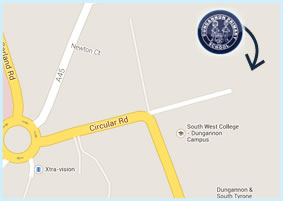
Dungannon Primary School,
Circular Rd,
Dungannon,
County Tyrone,
BT71 6BE
T: 028 8772 2250