Primary 7 FK
Welcome to Mr Kelly's Primary 7 Class!
Literacy - January - March 2026
PHONICS
· Different spellings of the sounds;/s/l/or/air/ue/oy
GRAMMAR & PUNCTUATION
· ‘Active’ and ‘passive’ in relation to verbs
· Know how to transform a sentence from active to passive and vice versa
· Know and understand what a compound sentence is.
· Investigate meanings and spelling of connectives.
· Understand how words and expressions have changed over time.
· Understand the relevance of the origins of proper names.
WRITING
· Know that information is presented to audiences through a variety of media, e.g. newspapers, magazines etc.
· Understand how different media present information, ideas and events in different way.
· Create newspaper reports
READING
· Guided reading throughout the week – reciprocal reading
TALKING AND LISTENING
· Group discussion: plan and manage a group task, taking on responsibility for an appropriate task.
· Drama: plan and create freeze frame scenes – related to WAU
World Around Us - January - March 2026
In WAU we are working in collaboration with ALMAC in delivering a series of Science Lessons with the following Learning Intentions.
· Understand what medicine is and why it is important.
· Understand that some medicines are found in the natural world and others are made by people.
· Understand different job roles involved in making medicines.
· Understand different skills needed to be a scientist.
· Understand the terms chemistry and biology.
· Provide examples of the three states of matter.
· Follow instructions to carry out a scientific experiment.
· Name the major organs within the human body.
· Understand the composition of blood.
· Explain the different ways our bodies let us know when we are sick or hurt.
· Understand the first stage of how a new medicine is developed.
· Understand how medicines are made in larger quantities in the manufacturing process.
· Awareness of different job roles involved in this stage of making medicines.
· Carry out scientific experiments.
· Work as part as team.
· Understand scientific terminology.
· Understand the importance of laboratory safety and warning signs.
· Describe the role of an engineer.
· Understand what a clinical trial is.
· Describe what is needed for a fair test.
· Create our own clinical trial.
· Participate in group and class discussions.
· Gather, organise and interpret data using tables, graphs and charts.
· Prepare and give a short oral presentation to a familiar group, showing an awareness of audience including the use of multimedia presentations.
· Identify and ask appropriate questions to seek information, views and feelings.
Numeracy - January - March 2026
Number
· Use negative numbers in context, and calculate intervals across zero
· Perform mental calculations, including with mixed operations and large numbers
· Understand the order of operations and use the BODMAS rule to carry out calculations involving the four operations and brackets
· Practice addition and subtraction for larger numbers, including both mental and written methods
· Make a reasonable estimate of the answer to a calculation and use this to check the answer
· Use a written method to calculate multiplication of HTO × TO
· Use mental methods to multiply a number with up to two decimal places by a one-digit whole number, e.g. 0·4 × 2 and 0·06 × 6
· Multiply one- or two-digit numbers with up to two decimal places by a one-digit whole number using a written method, e.g. 7·56 × 3 and 35·4 × 5
· Recognise common factors and common multiples
· Identify and create equivalent fractions
· Add and subtract fractions with different denominators and mixed numbers
· Divide proper fractions by whole numbers
· Multiply simple pairs of proper fractions
Simplify fractions by cancelling common factors
Measures
· Convert from one unit of mass to another, using decimal notation up to three decimal places where appropriate
· Calculate and convert between grams and kilograms to solve problems involving mass
Shape & Space
· Draw 2-D shapes using given dimensions and angles
· Use measuring tools and conventional markings and labels for lines and angles
· Use properties and sizes to compare and classify geometric shapes
· Find unknown angles in triangles, quadrilaterals and regular polygons
· Identify and name angles where they are vertically opposite
· Identify and name angles where they meet at a point, are on a straight line, or are vertically opposite
· Find missing angles expressing relationships algebraically, e.g. a = 180 – (b + c)
Contact Details
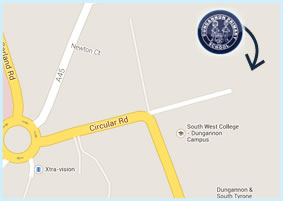
Dungannon Primary School,
Circular Rd,
Dungannon,
County Tyrone,
BT71 6BE
T: 028 8772 2250